How to Navigate Taxes
Taxes are unavoidable, but understanding how the system actually works can meaningfully change your outcome. As Judge Learned Hand famously put it, "Any one may so arrange his affairs that his taxes shall be as low as possible; he is not bound to choose that pattern which will best pay the Treasury."
How U.S. Taxation Works
Federal, state, and local taxes each play a different role — the federal government primarily collects income tax, states vary widely (some have no income tax at all), and local governments typically rely on property and sales taxes to fund community services.
Income Tax
Income tax is progressive — higher income is taxed at higher rates. For tax year 2025, the federal brackets are:
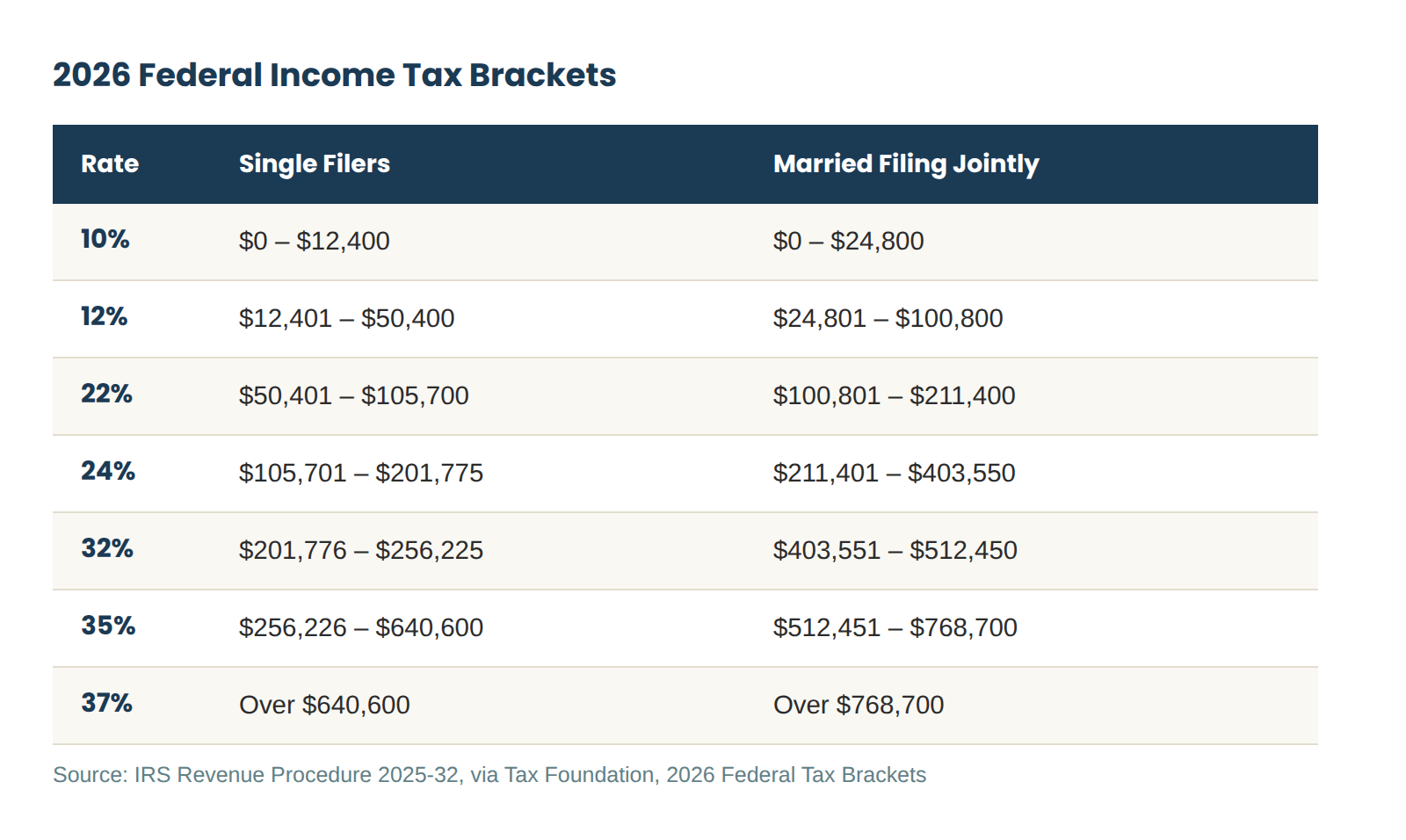
Worth knowing: ordinary income (wages, interest) and qualified dividends are taxed differently — dividends get preferential rates of 0%, 15%, or 20% depending on your income level.
Capital Gains Tax
Short-term gains (assets held one year or less) are taxed as ordinary income
Long-term gains (held over one year) get reduced rates of 0%, 15%, or 20%
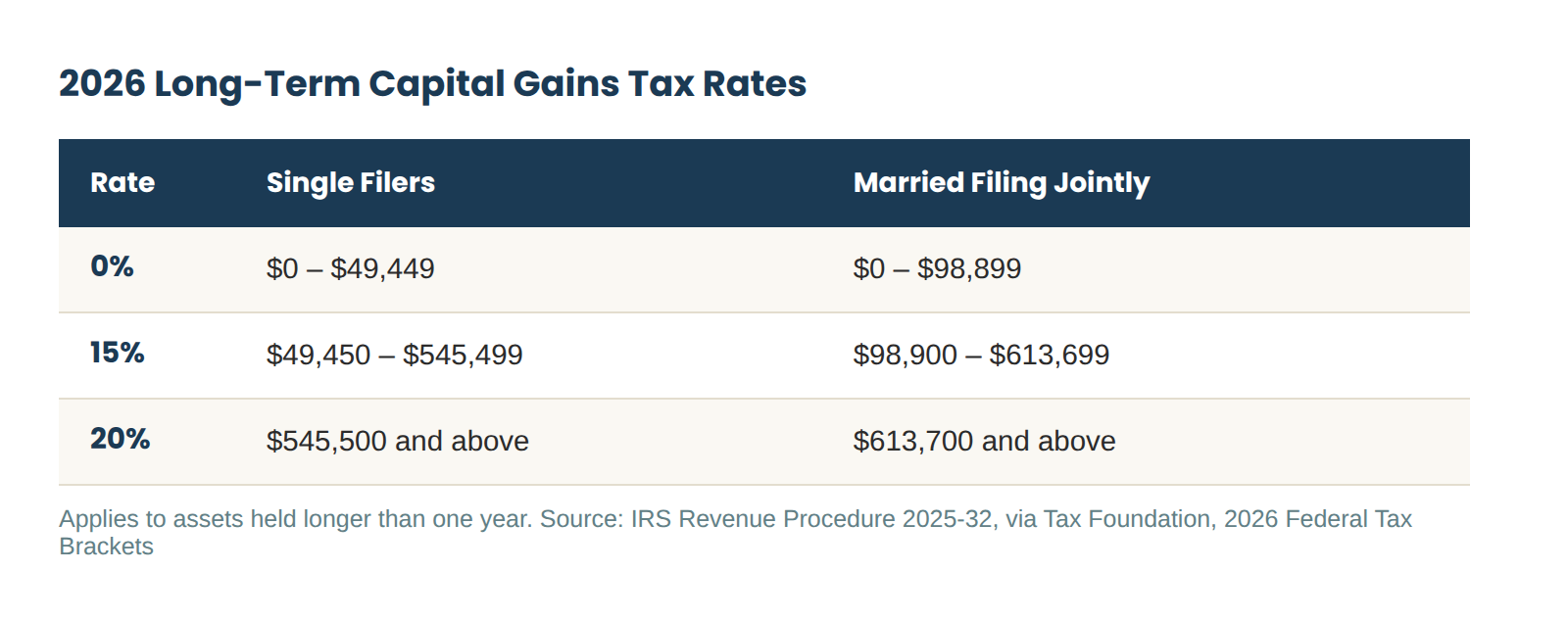
Ways to reduce what you owe: hold investments longer when practical, use tax-loss harvesting to offset gains with losses, and take advantage of tax-advantaged accounts like IRAs and 401(k)s.
Deductions and Credits
2026 standard deduction:
$16,100 for single filers
$32,200 for married filing jointly
$24,150 for heads of household
Common credits:
Earned Income Tax Credit — up to $664 with no children, up to $8,231 for three or more children, for low-to-moderate income workers
Child Tax Credit — $2,200 per qualifying child ($1,700 refundable)
American Opportunity Tax Credit — for education expenses
New for 2026: Key OBBBA Changes
The One Big Beautiful Bill Act (OBBBA), signed in 2025, introduced several new provisions taking effect for the 2026 tax year.
The New Senior Deduction
If you're 65 or older, this is likely the single most relevant change here. Starting in 2026, eligible seniors can claim an additional $6,000 deduction ($12,000 if both spouses are 65+), on top of the regular standard deduction — meaning a single filer 65+ could deduct as much as $24,050 before a dollar of income is taxed.
Must be 65 or older by December 31 of the tax year
Income limit: $75,000 (single/head of household) or $150,000 (married filing jointly) — the deduction phases out above these levels
Available for tax years 2025 through 2028
No Tax on Tips
A new, temporary deduction (2025–2028) allows eligible workers to deduct up to $25,000 of qualified tip income from federal taxable income. Tips must be voluntary — mandatory service charges don't qualify — and the deduction phases out for higher earners.
No Tax on Overtime
Similarly, eligible workers can deduct the premium portion of overtime pay — up to $12,500 (single) or $25,000 (married filing jointly) — also temporary through 2028, with a phase-out starting around $150,000 MAGI (single) or $300,000 (joint).
Other OBBBA Changes Worth Knowing About
OBBBA also adjusted rules around car loan interest deductions, the SALT (state and local tax) deduction cap, and charitable contribution and mortgage insurance deductions. These carry more specific eligibility rules than fit cleanly here — worth a conversation with a tax professional if any of these might apply to your situation. Just Click Here!
Sources: Tax Foundation (2026 tax brackets), IRS.gov (student loan interest deduction, EITC, Child Tax Credit, American Opportunity Tax Credit, 2026 inflation adjustments).